EFL Movie Study Guide for:
Secondhand Lions
from www.krigline.com www.krigline.com.cn
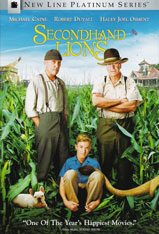
Story:
Are old lions still dangerous? Two formerly-lion-like bachelors (Hub and Garth) end up taking care
of a deserted nephew (Walter) and a “used” lion. Little by little the
stories of their amazing lives (and endless supply of cash) unfold—filled
with adventure, romance, exotic lands and treasure. But is it all true? Like
all of us, young Walter discovers that part of growing up is deciding who to
believe. (starring
Robert Duvall-Hub, Michael Caine-Garth, Haley Joel Osment-Walt; New Line Cinema, 2003; 2 hours; comedy, drama)
Setting: It starts and ends in the 1990s, but most of the movie is a
flashback to the early 1960s, with stories being told about things that
happened between 1919 and 1960. A lot of the music is from the 1950s.
Helpful background information: Walt (the boy) does not have a
father. His mom also lies to him a lot. One summer she decides to leave her
son with two rich uncles (whom she hardly knows). She wants to be free to
date a man, and hopes that the uncles will “like Walt so that when they die
they will give him money.” During the summer, Walt hears unbelievable
stories about his great-uncles' lives in Africa. They also tell him some of
the things “a boy needs to know in order to become a man.” Some common
guesses about where the uncles' money came from are: (1) in the 1920s they
were hit men for the Al Capone and the Mob; (2) they were bank robbers in
the 1920s; (3) they got rich by fighting a rich Arab, after rescuing a
beautiful woman from his castle (in defeat, he gave them lots of gold); (4)
they lived in a mental hospital for many years, and got the money from a law
suit.
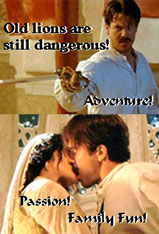
Note: The movie frequently uses
hyperbole to add humor (i.e., exaggerations
of movement or activity). For example, when the lion escapes, everyone in
the family gets a gun and goes after it (including the children!). In “real
life” you would not give a gun to a child, and two bachelors would not own
about 10 hunting guns, so these are both examples of hyperbole.
People and proper nouns:
Walter (Walt): a young teenage boy; his uncles help him grow up one summer
Hub: the "wild" uncle; as a young man, he was never afraid of anything
Garth: Hub's brother; a bit more understanding, Garth is a great brother and
uncle
French Foreign Legion: a famous part of the French colonial army made of
foreign volunteers
Mafia: a secret Italian criminal organization
that is also active in the US, involved in drug-dealing, gambling and other
crimes
Uncle Sam: a synonym for “the US Government”
Mae: Walt's irresponsible mother
Helen and Ralph: other relatives who hope Hub and Garth will give them their
money when they die (Ralph is a lawyer)
A few terms
(vocabulary):
credits: the list of names
telling who did what, both in the film and behind the scenes
hyperbole: exaggerated
statement not meant to be taken literally.
hit man: someone paid to
kill someone else (the Mafia has many “hit men,” so fear is one of their
tools)
traveling salesmen: people
who came to your door to sell you things (this was particularly common in
the 1950s and 1960s)
second-hand (or secondhand):
[adj] used; a way to describe sth that has had more than one owner
sissy: (noun or adj) an
offensive term referring to a boy who does not act in a masculine way (a boy
who is timid, weak, unwilling to fight, etc.)
skeet shooting: a sport
where contestants try to shoot a clay plate as it flies through the air
sleepwalking: to walk while
you are asleep, often acting out what you are dreaming about
state nuthouse: a
government-run hospital for crazy people
virtue: the personal quality
of being morally good or righteous
a will: a legal document
that says what should happen to your property & money after you die
A few
verbs
(more vocabulary):
to stash (money somewhere): to hide money in a secret place for storage
to do chores: to help a parent by cleaning, doing housework, taking care of
pets, gardening, etc.
to kick off: to die, to pass away
to shanghai (someone): to trick someone into going somewhere; esp. to get
someone drunk, put them on a ship, and make them work on the ship until it
reaches the next port
to need stitches: to have deep wounds that will require a doctor who can sew
them up
Phrases & sentences from the film:
(you will find more below, or at
http://www.imdb.com/title/tt0327137/quotes)
“If you stay, our other relatives will leave us alone.” In the movie, the
old men liked to be alone, but their relatives acted friendly in the hope of
getting some of the money when the men died. They asked Walt to stay, in the
hope that the other relatives would stop visiting them.
“That’s not very sporting.” That is not fair; if you do that, you lack
integrity.
“It’s a defective, used lion.” This indicated that the lion was not what
they expected; it was too old to provide a sporting challenge.
“Why does the bad guy get filthy rich?”
The "bad guy” is the villain or enemy in a
story, and he usually gets punished, so Walt thinks it is strange that the
“bad guy” in his uncle's story gets very, very rich (when oil is discovered
on his property)
“You want to say something? Well, spit it out.” “Spit is out” is a command
to stop hesitating and say what is on your mind.
“I see what you’re trying to pull.” I see through your deception; I know
what you are trying to trick me into doing.
“If I’m going to stay, there’s gonna be some conditions.” You will be
required to do some things or stop doing some things, if you want me to
stay.
“the works” means “and everything else” or “etc.”
“They went out with their boots on.” A common phrase from cowboy movies,
meaning that someone died while doing what they wanted to be doing,
instead of just sitting around and waiting for death.
“He really lived.” He was not just alive/breathing; his life was
really full of life and activity.
My favorite dialog (part of Hub’s “What every boy needs to know to be
a Man” speech). It was a response to Walt saying: “I don’t know what to
believe in.”
“If you want to believe in something, then believe in it. Just because
something isn’t true, there’s no reason you can’t believe in it. Sometimes
the things that may or may not be true are the things that a man needs to
believe in the most: that people are basically good; that honor, courage and
virtue mean everything; that power and money mean nothing; that good always
triumphs over evil; that true love never dies. It doesn’t matter if they are
true or not. A man should believe in those things, because those are the
things worth believing in.”
Discussion:
(A) Walt’s mom was a widow, and in the 1960s there were not many jobs open
to women. It was particularly difficult to be a “single mom.” In what ways
does this excuse or explain her behavior?
(B) If she HAD been going to a school to learn “court reporting,” do you
think she should have taken her son along, or found someone (like the
uncles) to watch her son for a few weeks? Explain your answer.
(C) In what ways has life gotten easier for women since the 1960s (in
China)? In what ways is life still more difficult for women than for men?
(D) The UK, India, and many other countries have had a female Prime Minister
or President. Do you think your country will
ever have a female "top" leader? Why or why not?
(E) Talk about the older men or women in your life (those who are at least
35 years older than you). What did you learn from them? In what ways was it
difficult to be around them (how were they “odd” or “strange”). Why is it
important for children to be around older people?
(F) At first, Walt believed that he was going to have a miserable summer
with his uncles, but by the end of the movie he loved them and chose to live
with them. Tell your small group about a time when your belief about
something changed.
(G) Re-read "My favorite dialog" above. Where do our beliefs and values come
from? Most people experience a change in “what they believe” over time
throughout their lives. In what ways is this good or bad?
(H) Are there things that ALL people in the world should believe in, or does
there have to be a difference because of culture? Explain your answer.
(I) What might “universal beliefs” be?
(J) How many of the following do you think most of the people in the world
would agree on as being “good rules” for all people:
1. Do not crave or long for someone else’s wife, house, or possessions.
2. Do not lie in court or say untrue things if that will bring harm to your
neighbor.
3. Do not steal.
4. If you are married, do not sleep with anyone except your husband or wife.
5. Do not murder.
6. Honor your father and your mother.
7. One day per week, take a rest from your normal work
8. Do not curse or swear. Do not abuse God’s name or use it carelessly.
9. Do not worship images or statues, because the Heavenly Father does not
look like anything you can make with your hands.
10. There is only one true God, who created the world and who revealed
himself through the Bible. Do not worship anyone or anything else.
(K) Do you know where the list above came from? It is called “the ten
commandments,” recorded 4000 years ago as the "basic laws for humanity."
These commandments also provided the foundation for law in Europe, America
and the Middle East.
(L) It is said: “If you don’t have something to die for, you don’t have
anything to live for.” What do YOU believe in so strongly that you might
risk everything for it?
(M) At the end of the movie, Walt said his uncles had “really lived;” that
is, they had really led full and meaningful lives. What do you think Walt
was talking about—what had his uncles done that was “really living”? When
you reach 70 or 80, what do you hope to look back on?
A few more lines/dialogs (mostly from http://www.imdb.com/title/tt0327137/quotes):
[first lines]
Adult Walter: [answering the phone] Hello?
Sheriff: Walter?
Adult Walter: Yes.
Sheriff: This is Sheriff Brady. I'm afraid I have some bad news for you.
It's about your uncles.
Mae: (to Walter, who is afraid of several dogs) Show them you're friendly,
Honey! Let 'em sniff your hand.
Hub: WE'RE OLD, DAMNIT! LEAVE US ALONE!
Garth: The last thing we need is some little sissy boy hanging around
all summer.
Walter: So, you two were away for 40 years... Where'd you go?
Walter: (after being told that they don't have a phone) Is it okay if I go
inside and watch television?
Garth: Ain't got one.
Walter: No television?
Hub: You know what I don't like about houseguests? [slams fist on table]
Dinner table Chit-Chat Chit-Chat. (i.e., mindless conversation)
Hub: We're fixin' to die anytime, so if we kick off in the middle of
the night, you're on your own
Helen: You take him to the orphanage right this minute.
Hub: Whether we take him to the orphanage or tie him up and throw him in the
lake, that's OUR business, not yours.
Walter: (who overhead Helen and Hub, and ran away) I've been to the orphan
home before. I don't wanna go back.
Walter: What's wrong with him?
Garth: Well, a man's body may grow old, but inside his spirit can still be
as young and as restless as ever. And him, in his day, he had more spirit
than twenty men.
[Hub and Garth are getting ready to shoot at a traveling salesman]
Walter: Why not see what he's sellin'?
Hub: What the hell for?
Walter: Well what's the good of having all that money if you're never gonna
spend it?
Garth: Could be the kid has a point.
Hub: Well. We'll see what the man's sellin'. THEN we'll shoot him.
Garth: Good plan.
Walter: You bought a used lion?
(The men explain that they want to shoot him, but not "sitting in the
crate")
Walter: Can I keep her? I've never had a pet before!
Hood 1: Hey, who do you think you are, huh?
Garth: He's just a dumb kid, Hub. Don't kill him.
Hub: [to Garth] Right.
[Grabs Hood 1 by the throat]
Hub: I'm Hub McCann. I've fought in two World Wars and countless smaller
ones on three continents. I led thousands of men into battle with everything
from horses and swords to artillery and tanks. I've seen the headwaters of
the Nile, and tribes of natives no white man had ever seen before. I've won
and lost a dozen fortunes, KILLED MANY MEN and loved only one woman with a
passion a FLEA like you could never begin to understand. That's who I am.
NOW, GO HOME, BOY!
Garth: The Sheik *knew* that he would sure die now, without even the right
to beg for mercy... But Hub just said "Twice I have held your life in my
hands. And twice I have given it back to you. The next time..."
Young Hub: Your life is mine!
Stan: It's up to you, kid. We can be friends, or we can be enemies. What's
it gonna be?
Walter: [looks down, thinking, then looks up] Defend yourself!
Stan: What?
Hub: [to Stan, after the lion attacked him for beating Walter] You're lucky
the lion got to you before *we* did.
Garth: [after Walter leaves] A salesman should be by in about three, four
hours.
Hub: Whoop-de-do.
Walter: Has he hit YOU yet?
Mae: MIND YOUR OWN BUSINESS!
Walter: If I'm gonna live here, there's gonna be some conditions
Hub: conditions?
Walter: No more dangerous stuff. No more fighting teenagers. No airplanes.
More vegetables, less meat.
Hub: What do ya want me to do? Die of old age?
Sheriff: Best I can figure, they were trying to fly through that barn,
upside down.
Adult Walter: [reading his uncles' will] The kid gets it all. Just plant us
in the damn garden, next to the stupid lion.
(The Sheil's son and grandson heard about the death of Hub and Garth on CNN,
in Houston--not too far away.)
Sheik's Grandson: [looking at a large yacht in a small pond] I see they
spent my grandfather's gold well.
Adult Walter: [laughing] Well, there was this one travelling salesman...
[last lines]
Sheik's Great Grandson: So, these two men from your grandfather's stories,
they really lived?
Adult Walter: [wistfully] Yeah, they really lived...




















































