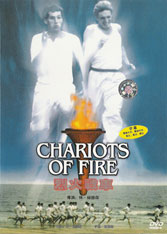
EFL Movie Study Guide for:
Chariots of Fire
from www.krigline.com
www.krigline.com.cn
There is a quiz about this movie at the bottom of this page!
Story: The first China-born Olympic medalist was Eric Liddell (born
in Tianjin, China). This film tells the story of Eric Liddell and Harold
Abrahams, leading up to the 1924 Olympics. Along the road to victory they
face life-changing choices when conflicting demands come from family
members, friends, leaders, rules, traditions, outdated ideas, heritage,
faith, country, and their own convictions. Where does the power come from,
to see the race to its end? Watch this classic film and find out! (Eric
returned to China from the UK in 1925; his fame raised money to build
Tianjin’s Mingyuan stadium; he served as a teacher and doctor until he died
in a Japanese camp for foreigners in 1945.) (1981; four Oscars including
Best Picture; drama, sports, history; 123 min)
Setting: The UK and Paris, early 1920s
Note 1:
This film uses the flashback
technique: it starts in 1978 at Harold’s memorial service, then goes back to
1924 (before leaving for Paris), then to 1919 when Harold enters Cambridge,
then 1920 to meet Eric; it then works up to the 1924 Olympics, and finally
ends in 1978.
Note 2:
Another technique this film uses a lot is slow motion; that is, a 10-second
race takes 30 seconds, so you can see more details. This technique also
emphasizes the lonely feeling and nervousness that runners feel just before
a race.
Note 3:
Until recently, professional athletes (i.e., athletes who earned money for
participating in sports) were not allowed to compete in the Olympics. In the
early days, they were not even allowed to hire a personal coach. This is one
of the issues in this story.
Note 4:
At one point, Harold says that Eric “runs like a wild animal”—this is
historically true! The actor had a hard time imitating Eric, whose arms
swung wildly and whose head tilted back so far that he couldn’t really see
the track!
Note 5:
As you watch, think about the things you must struggle with to reach your
potential. Eric’s parents supported his “running” but his sister saw it as a
distraction; Eric’s religious beliefs also kept him from running on Sunday
(“the Lord’s day”), though his countrymen called him a “traitor” for loving
God more than he loved his country. Harold’s struggle was mostly with ethnic
prejudice and with university leaders whose “amateur only” policies forbid
athletes from hiring a personal coach. You probably face different
challenges, but watching these “legends” can help you see a way forward, no
matter what you struggle with!
Characters:
Harold Abrahams: a Jewish student at
Cambridge University, who “runs like the wind”
Sybil Gordon: Harold’s girlfriend, who is
also a talented singer/performer
Eric Liddell: a China-born Scottish athlete,
known for excellence in “football,” and torn between preparing for a medical
career and his love of running
Jennie Liddell: Eric’s sister, who thinks
that sports are interfering with her brother’s future
Lord Andrew Lindsay: a wealthy Cambridge
student who is also on the track team
Sandy McGrath: a family friend of the
Liddells, who acts as Eric’s unofficial coach
Aubrey Montague: another member of the
Cambridge track team, and the person who narrates this story
Sam Mussabini: a professional track coach
who accepts Harold’s invitation to help him run faster
The Prince of Wales: the future UK King
Edward VIII; also called “David” by his friends
American Olympic runners
include Charles Paddock and Jackson Scholz: “the fastest men on earth”
A few terms (vocabulary):
addicted: unable to stop taking or doing something (a drug,
habit, etc) [an addict is sb who is addicted]
allegiance: loyalty
amateur: not professional; someone who does sth (like a sport
or job) for fun, not for money
arrogance: the attitude of sb who behaves in an unpleasant or
rude way because he thinks he is more important than other people [such a
person is arrogant]
Christian: someone who believes in the basic truths of the
Christian Bible, in particular: (1) Jesus is part of the Trinity (a 3-person
union of Father, Son and Holy Spirit in one God); (2) that sin (human
imperfection) makes a human-God relationship as impossible as a relationship
between a dirty stick and a hot fire; (3) that Jesus’ death on the cross
brings forgiveness of sin to anyone who believes; and (4) that Jesus’ was
raised from the dead to show God’s power, both to do miracles and to forgive
sin, and thus to allow sinful humans to nonetheless have an eternal
relationship with a holy God
compulsion: a strong push or pressure to do something (“It’s
a compulsion; I can’t stop smoking no matter how hard I try.”)
conscience: the part of your mind that helps you decide what
is right and wrong
contentment: a state of being satisfied; “A discontent
person is always trying to get more, but contentment is a key to
happiness.”
defensive: acting in a way to defend or protect oneself, or
one’s race, team, country, etc. (“Their defensive team was great—the
opponent could not score.” “You don’t have to get defensive, I was
not criticizing you.”)
elation: extreme (and often brief) feeling of happiness and
excitement
flashback: a scene or event in a story or film, shown out of
its normal time-order (e.g., going back to show the audience how something
happened)
formula: a method for doing something so that you always get
the same results (“The only formula for success in learning a language is
‘work hard for a long time’.”)
gut: a body’s internal organs, but usually used figuratively
to indicate courage or a deep conviction about something (“He had a gut
feeling that this was the right answer.” “A gut runner is motivated by
something deep inside.”)
heats: (sports term) a preliminary race—those who win (or
perhaps the top two) will compete against other athletes later for the
championship
heel: the back part of your foot (“They ran as if they had
wings on their heels.”)
impertinence: showing disrespect, esp. to someone more
important than yourself
Jew/Jewish: the ethnic group (race) descended from Abraham’s
grandson Israel, “chosen” by God, through whom to reveal His laws and His
character, and through whom He planned to provide salvation for Jews and
Gentiles (non-Jews) [the adjective form is Jewish; Jews are also
called “the Chosen People”]; throughout history, Jews have experienced a lot
of religious persecution (remember that this story takes place about a
decade before World War 2 [1937-1945], when Hitler murdered over six million
Jews in what is known as “the Holocaust”)
juvenile: [often negative] childish or in a immature way
Sabbath: to Christians, this means “Sunday” or “the Lord’s
Day”; to strict Jewish people it is from sunset Friday to sunset Saturday;
to strict Jews and Christians, people should use this day for worship and
rest (not work)
to sever: to cut
sprint: a short, fast run or race (esp. 100 meters in about
10 seconds) “A sprinter (runner) sprints (runs fast) in a
sprint (a race or sporting event).”
stride: the distance between your feet as you walk or run; to
“overstride” means to run with too long a step—he shouldn’t put his foot so
far in front of his other foot
Phrases & expressions from the movie:
to “break the tape”: to be the first person to pass the
finish line in a race
“You could’ve fooled me”: I don’t agree with you
“a sticky moment”: a difficult or dangerous moment/situation
“to pop the question”: to ask someone to marry you
“grin and bear it”: to accept an unwanted condition without
complaint, often because you can’t really change things. (“Grin and bear it?
No way—I’m going to change the situation!”)
persona non grata: [Latin] not
welcome (here, coach Mussabini
was officially not allowed to be in the stadium)
Comments from a former student:
Chariots of Fire
is a movie that wants to show us a kind of "spirit of fire," and it contains
so many things: faith, victory, belief, struggle, love.... It's what a good
movie should have. You do not have to be a sports fan to appreciate the
movie. You just have to have a heart. You have to bear minutes of intense
running without taking a breath. --Allen (2004 NPU)
Discussion:
1. In the opening segment, Lord Lindsay calls Harold Abrahams
a “legend.” How does a person get to become a “legend”?
2. The Olympics were held for 12 centuries before stopping in
AD 393. They started again in 1896. Think about all the things that have
happened during the Olympics since then, good things and bad things. Do you
think it was a good or bad idea to “restart” the Olympics? Explain your
answer.
3. Runners Harold and Eric faced many pressures and
conflicting demands. Tell your partner what the main pressures were for each
runner. Then ask your partner to tell you how each runner coped with those
pressures.
4. How do we decide which “conflicting demand” deserves our
attention and obedience? That is, when we are “between” two demands from two
important people or sources (e.g., your dad and your teacher, or your career
and your personal beliefs about right & wrong), who/what helps us to know
how to decide?
5. What is the greatest source of pressure in your life right
now? How do you cope with that pressure?
6. Name
five “great” people from the past. Ask your partner what kind of pressure or
opposition they had to overcome. Is it possible to become historically
“great” or “legendary” without facing pressure or opposition? Explain your
answer.
Sentences or conversations from the movie:
(from http://www.imdb.com/title/tt0082158/quotes;imdb's website is a great place to find
movie facts and more)
Note: some of these have been shortened or simplified a little for my
students (especially if marked with *); others stick to the subtitles even if they aren't exactly like the
dialog.
Say these dialogs out loud with your friends; it will help you prepare to
watch the movie. Underlined terms are in the vocabulary section
above.
1. Lord Lindsay: Let us praise famous men and our fathers
that begat us. All these men were honoured in their generations and were a
glory in their days. We are here today to give thanks for the life of Harold
Abrahams. To honour the legend. Now there are just two of us - young Aubrey
Montague and myself - who can close our eyes and remember those few young
men with hope in our hearts and wings on our heels.
2. Jennie Liddell: He may be your best friend, Sandy, but
he’s my best brother. Eric’s special to me. Precious. I don’t want his work
spoilt with all this running talk, do you hear?
3. Eric Liddell: When we were in China, my father was
always waxing lyrical about his wee home in the glen [i.e., Dad spoke
poetically about his little house in Scotland]. But being oriental-born
myself, like my brothers and my sister, I suffered from a natural
incredulity [disbelief]. But looking about me now— the heather on the
hills…. I can see he was right. It’s very special. Thank you for welcoming
us home and for reminding me that I am, and will be whilst I breathe, a
Scot.
4. Eric Liddell: You came to see a race today. To see
someone win. It happened to be me. But I want you to do more than just watch
a race. I want you to take part in it. I want to compare faith to running in
a race. It's hard. It requires concentration of will, energy of soul. You
experience elation when the winner breaks the tape -
especially if you've got a bet on it. But how long does that last? You go
home. Maybe you're dinner's burnt. Maybe you haven't got a job. So who am I
to say, "Believe, have faith," in the face of life's realities? I would like
to give you something more permanent, but I can only point the way. I have
no formula for winning the race. Everyone runs in her own way, or his
own way. And where does the power come from, to see the race to its end?
From within. Jesus said, "Behold, the Kingdom of God is within you. If with
all your hearts, you truly seek me, you shall ever surely find me." If you
commit yourself to the love of Christ, then that is how you run a straight
race.
5. Sybil Gordon: Why running?
Harold Abrahams: Why singing?
Sybil: It’s my job—no, that’s silly. I do it because I
love it. Do you love running?
Harold: I'm more of an addict. It's a
compulsion, a weapon.
Sybil: Against what?
Harold: Being Jewish I suppose.
Sybil: [laughs incredulously] You're not serious!
Harold: You're not Jewish, or you wouldn't ask.
Sybil: Fiddlesticks! People don't care.
6. Harold Abrahams: I run to win. If I can't win, I won't
run!
Sybil Gordon: If you don't run, you can't win.
7. Sam Mussabini: Eric Liddell? He's no real problem...
Harold M. Abrahams: [Eric has already beaten Harold
once] You could’ve fooled me.
Sam Mussabini: Yeah, he's fast! But he won't go any
faster. He's a gut runner, digs deep! But a short sprint is
run on nerves. It's tailor-made for neurotics.
8. Sam Mussabini: Do you want to know why you lost the
other day? [Harold nods] You're over striding. [Sets coins in a row]
Now these coins represent the strides in your hundred meters. [Pushes
coins together] Have you got another two coins, Mr. Abrahams? As I said,
over striding. {It is] Death for the sprinter. Slap in the face each stride
you take. Knocks you back. [Slaps Harold across the cheek. Harold winces]
Like that! [Slaps Harold again] And that!
9. Eric Liddell: I believe God made me for a purpose, but
he also made me fast. And when I run I feel His pleasure.
10.* Cambridge University official 1 (Master of Caius
College): Here at Cambridge, we’ve always been proud of our athletic
prowess. We believe that our games are indispensable in helping to complete
the education of an Englishman. They create character. They foster courage,
honesty and leadership, but most of all, an unassailable spirit of loyalty,
comradeship and mutual responsibility….
Cambridge University official 2: It is said that you
use a personal coach.
Cambridge University official 1: The university
believes that the way of the amateur is the only one to provide
satisfactory results….
Harold Abrahams: You know, gentlemen, you yearn for
victory, just as I do, but achieved with the apparent effortlessness of
gods. Yours are the archaic values of the prep school playground. [i.e., the
outdated thinking of sports as "games for children"] You deceive no one buy
yourselves. I believe in the pursuit of excellence, and I’ll carry the
future with me.
11. Lord Birkenhead [(on the British Olympic Association)
trying to pressure Eric into violating his own conscience]: The
Prince of Wales would like to meet you.
Eric Liddell: No, sir. It wouldn’t be right.
Birkenhead: Liddell, he is your future king, are you
refusing to shake his hand? Does your arrogance extend that far?
Eric: My arrogance, sir, extends just as far as my
conscience demands.
Birkenhead: Fine, then let's hope that is wise enough
to give you room to manoeuvre. [AmE: maneuver]
12. His Royal Highness Edward, Prince of Wales: We have to
explore ways in which we can help this young man to reach that decision [to
run on Sunday].
Eric Liddell: I’m afraid there are no ways, sir. I
won’t run on the Sabbath, and that’s final. I intended to confirm this with
Lord Birkenhead tonight, even before you called me up before this
inquisition of yours.
Lord Cadogan (chairman of the British Olympic
Association): Don't be impertinent, Liddell!
Eric: The impertinence lies, sir, with those who
seek to influence a man to deny his beliefs!
Cadogan: In my day it was King first and God after.
Duke of Sutherland (another member of the committee):
Yes, and the “war to end wars” [World War 1] bitterly proved your point!
Eric: God made countries. God makes kings, and the
rules by which they govern. And those rules say that the Sabbath is
His. And I for one intend to keep it that way.
Prince of Wales: There are times when we are asked to
make sacrifices in the name of [our common] loyalty. And without them our
[national] allegiance is worthless. As I see it, for you, this is
such a time.
Eric: Sir, God knows I love my country. But I can't
make that sacrifice.

Lord Lindsey [enters the room and suggests]: Another
day, another race. [That is, let Eric switch from 100-meters on Sunday to

400-meters on Thursday. The committee agrees.]
Duke of Sutherland: A sticky moment, George.

Lord Birkenhead: Thank God for Lindsay. I thought the

lad had us beaten.
Duke: He did have us beaten, and thank God he did.
Birkenhead: I don't quite follow you.
Duke: The "lad", as you call him, is a true man of
principles and a true athlete. His speed is a mere extension of his life,
its force. We sought to sever his running from himself.
Birkenhead: For his country's sake, yes.
Duke: No sake is worth that, least of all a guilty
national pride.
13. [While we watch his teammates compete on Sunday, Eric is
giving a speech at a church in Paris, quoting from Isaiah 40—a well-known
part of the Bible]: “They that wait upon the Lord shall renew their
strength. They shall mount up with wings, as eagles. They shall run and not
be weary. They shall walk and not faint.”
14.
Harold Abrahams [to his teammate]: You, Aubrey, are my most complete man.
You're brave, compassionate, kind: a content man. That is your secret:
contentment. I am 24 and I've never know it. I'm forever in pursuit and
I don't even know what I am chasing…. And now in one hour's time I will be
out there again. I will raise my eyes and look down that corridor, four feet
wide, with ten lonely seconds to justify my whole existence. But WILL I?
Aubrey, I've known the fear of losing but now I am almost too frightened to
win.
-------------------------------
Here are some
more websites that can tell
you about Eric Liddell, especially in relation to China.
http://www.chinadaily.com.cn/cndy/2009-08/06/content_8530706.htm
http://www.hyperhistory.net/apwh/bios/b3liddell10lu.htm
http://en.wikipedia.org/wiki/Eric_Liddell
http://www.calthomas.com/index.php?news=172
http://www.times-olympics.co.uk/historyheroes/stgbo01.html
This website says: "In 1991, more than 40 years after he died and a decade
after his life was immortalised on celluloid [film], a small headstone was
unveiled at Liddell's previously unmarked grave in China's Tientsin province
[Tianjin Municipality]. An appropriate text, just a few simple words taken
from Isaiah, formed the inscription: ‘They shall mount up with wings as
eagles; they shall run and not be weary.’"
Some interesting details from:
Benge, Janet and Geoff. Eric Liddell: Something Great than
Gold. Seattle: YWAM Publishing, 1998. ISBN 1-57658-137-3
Eric also won a bronze medal in the 200 meter race.
The day of the 400 meter heats was 45 degrees centigrade. Two
men (one Swiss and one Brit) had broken the world record during the heats
(48 seconds). Eric was the shortest of the six finalists (2 Brits, 1
Canadian, 2 Americans, and 1 Swiss).
Eric set a new world record by winning the 400 meter race:
47.6 seconds.
The
day after his victory, the same Scottish newspapers that had called Eric a
coward and traitor for refusing to run on Sunday, were now showering him
with praise and calling him a national hero.
-------------------------------
Below is a quiz
I gave to former students about the movie. Try it (it is not very difficult)
before you look at the answers!
-------------------------------
Chariots of Fire
Quiz
Choose the correct answer.
1. Harold Abrahams and Eric Liddell are
A. runners
B. classmates
C. friends
2. Eric Liddell was on the Olympic Team for
A. France
B. China
C. England
3. The 1924 Olympics were held in
A. London, England
B. Paris, France
C. Sydney, Australia
4. Sam Musambini was Harold’s
A. father
B. friend
C. coach
5. Which runner did NOT win an Olympic gold medal?
A. Jackson Schultz
B. Eric Liddell
C. Harold Abrahams
6. Harold Abrahams faced prejudice because
A. he didn’t run fast enough
B. he was Jewish
C. he was a Cambridge University student
7. Cambridge University leaders were upset with Harold
Abrahams because
A. he was using a professional coach
B. he had said “If I can’t win, I won’t run”
C. he had lost a race to Eric Liddell
8. English leaders were upset with Eric Liddell because
A. his sister did not want him to run
B. he wanted to go back to China
C. he believed running on Sunday would break God’s
law
9. When Eric said, “God made countries and God makes
kings,” he meant
A. I am very religious
B. God’s laws are more important than the laws
written by world leaders
C. countries and kings are not important
10. True Olympic athletes see other Olympic athletes as
A. enemies to beat
B. friends to help
C. competitors who push each other to be the best
they can be
Chariots of Fire, movie quiz answer key: 1A. 2C. 3B.
4C. 5A. 6B. 7A. 8C. 9B. 10C